
Journal
Peptide Pricing Comparison: Maximizing Your Research Budget for High-Quality Peptides

Introduction
Fellow researchers and scientists, we understand the critical balance between scientific rigor and budgetary constraints. The cost of research materials can significantly impact the scope and progression of your projects. When it comes to acquiring essential research peptides, navigating the market to find the best value without compromising on quality is a significant challenge. This guide is dedicated to empowering you with the knowledge needed for effective Peptide Pricing Comparison. We’ll explore the key factors that influence peptide pricing, offer insights into how to assess value beyond just the sticker price, and guide you towards making informed decisions that stretch your research budget further. Get ready to learn how to secure affordable, high-quality peptide options and ensure you’re getting the best possible value for your next critical purchase.
Understanding the Factors Influencing Peptide Pricing
The cost of a peptide isn’t arbitrary; it’s determined by a complex interplay of scientific, production, and market-driven factors. Understanding these elements is the first step in conducting a meaningful Peptide Pricing Comparison.
1. Purity and Quality Standards
This is arguably the most significant driver of cost.
- High Purity Requirements: Peptides destined for sensitive research applications (e.g., pharmaceutical development, in-vivo studies) demand extremely high purity levels (often >98% or >99%). Achieving and verifying this level of purity requires sophisticated purification techniques (like HPLC) and extensive quality control measures (MS, HPLC analysis), all of which add to the production cost.
- Third-Party Verification: Suppliers who invest in independent, third-party laboratory testing and readily provide detailed Certificates of Analysis (COAs) often have higher pricing, reflecting the added assurance of quality.
2. Synthesis Complexity and Peptide Length
The nature of the peptide itself plays a crucial role.
- Length of the Peptide Chain: Longer peptide sequences require more amino acids, more synthesis steps, and often result in lower yields, thus increasing the overall cost.
- Difficult Sequences: Certain amino acid sequences are inherently harder to synthesize due to their chemical properties, potentially requiring specialized reagents or longer reaction times, which drives up the price.
- Modifications and Derivatizations: Peptides with special modifications (e.g., cyclization, phosphorylation, biotinylation, fluorescent labeling, incorporation of non-natural amino acids) require additional complex steps and specialized reagents, significantly increasing the cost compared to simple linear peptides.
3. Production Scale and Yield
How and how much the peptide is produced impacts the price per unit.
- Scale of Synthesis: Producing peptides in larger batches (e.g., grams or kilograms) generally leads to a lower cost per milligram compared to small-scale synthesis (milligrams) due to economies of scale.
- Achieved Yield: The efficiency of the synthesis process directly affects cost. If a synthesis yields a lower amount of the desired peptide, the cost per unit will be higher to compensate for the reagents and labor involved.
4. Supplier Costs and Business Model
The operational costs and market positioning of the supplier are also factors.
- Research & Development Investment:Companies investing heavily in R&D for new synthesis methods or novel peptides may reflect these costs in their pricing.
- Quality Control Infrastructure: Maintaining advanced analytical equipment and skilled personnel for rigorous QC is expensive.
- Customer Service and Support: Suppliers offering robust technical support, expedited shipping, and detailed documentation often have higher operational costs.
- Market Competition: The presence of numerous suppliers can create competitive pricing, while niche markets or suppliers with unique technological advantages might command premium prices.
By considering these factors, you can move beyond a simple numerical Peptide Pricing Comparison and begin to assess the true value offered by different suppliers.
[Image Placeholder 1: A graphic illustrating various factors influencing peptide cost, such as purity level, peptide length, modifications, and QC measures, perhaps arranged in a circular diagram.]
Strategies for Effective Peptide Pricing Comparison and Value Assessment
When you need to buy research peptides, simply comparing the listed price per milligram can be misleading. A smart approach involves looking deeper to ensure you’re getting the best value for your budget.
1. Beyond the Sticker Price: What’s Included?
Always scrutinize what is included in the listed price.
- Purity Level: Is the listed price for a >95% or a >99% pure peptide? A slightly higher price for a significantly purer product can often be more cost-effective in the long run by preventing costly experimental errors.
- Included Analysis: Does the price include a comprehensive COA with HPLC and MS data? Some lower-cost options might only provide basic analysis or none at all.
- Modifications: Ensure the price is for the exact peptide sequence and modifications you need. Adding complex modifications can drastically alter the price.
- Quantity Breakpoints: Many suppliers offer discounts for larger quantities. Compare pricing across different order sizes if you anticipate needing more peptide later.
2. Evaluating Supplier Reputation and Reliability
The cheapest option is rarely the best value if the quality is suspect.
- Review Quality Control Practices: Prioritize suppliers who are transparent about their QC processes and provide detailed COAs. Look for evidence of third-party verification.
- Check Customer Reviews and Testimonials:What is the general consensus on the reliability and consistency of peptides from different suppliers? Community feedback can be invaluable.
- Consider Turnaround Time: While not directly a price factor, a supplier with consistently slow delivery can indirectly cost you money in delayed research timelines. Factor in reliability alongside cost.
3. Calculate the “True Cost” Per Reliable Experiment
Think about the cost in terms of experimental success.
- Cost Per Experiment: If a cheaper peptide leads to failed experiments due to impurities, its “true cost” is much higher than its listed price. Calculate the cost based on the amount needed for a successful, reproducible experiment.
- Long-Term Value: A slightly more expensive peptide from a highly reputable supplier might offer better long-term value through consistent quality, reliable delivery, and excellent technical support, saving you time and resources in the long run.
By employing these strategies, your Peptide Pricing Comparison becomes a more nuanced assessment of overall value, ensuring your research budget is allocated effectively towards high-quality, reliable materials.
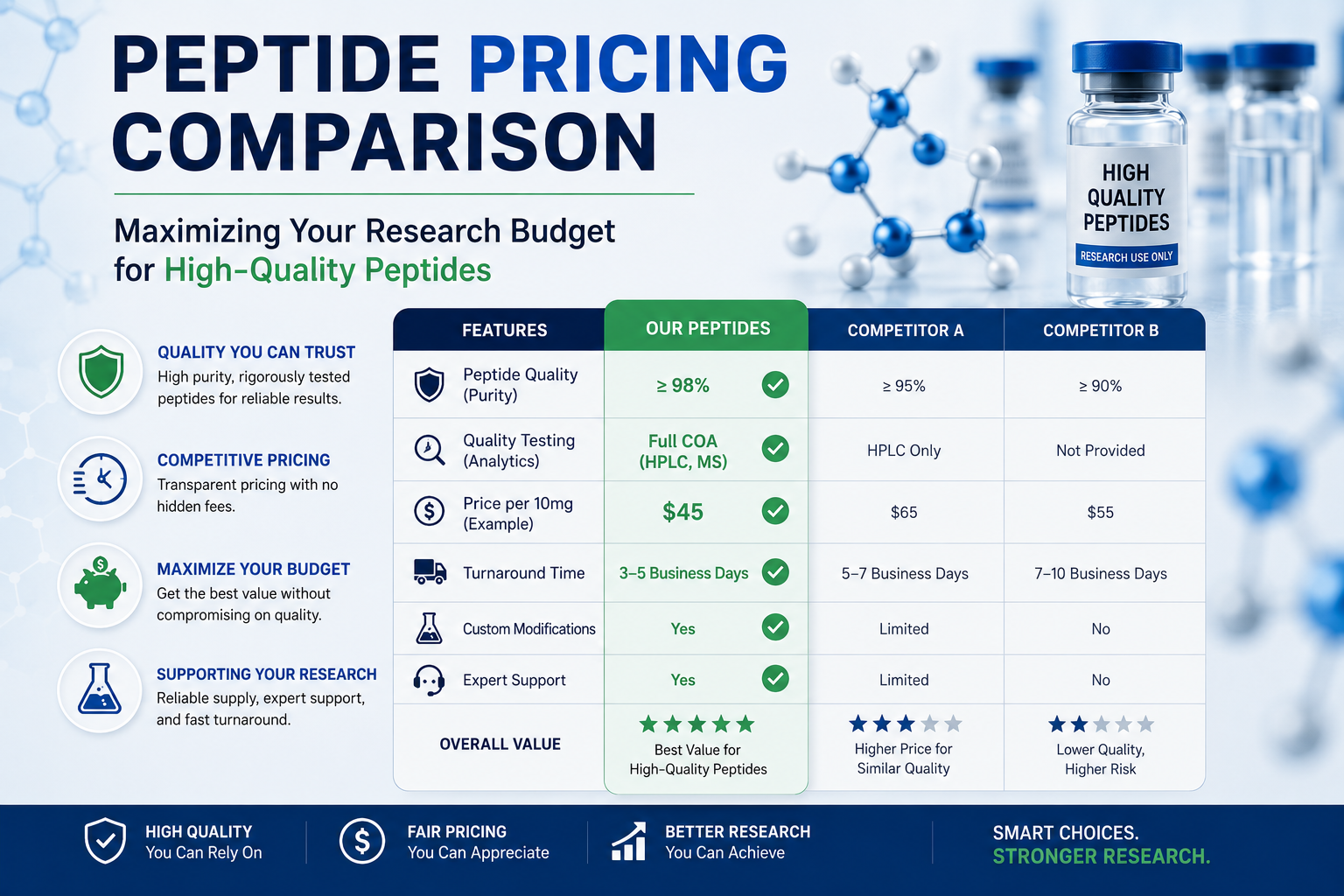
[Image Placeholder 2: A graphic comparing two hypothetical peptide options. Option A is cheaper but has less detailed QC/COA. Option B is slightly more expensive but includes comprehensive COA, third-party testing, and faster shipping, with a “Best Value” indicator pointing to Option B.]
Finding Affordable, High-Quality Peptide Options
It’s possible to find excellent value in the peptide market. Here’s how:
- Compare Reputable Suppliers: Don’t just look at one or two vendors. Create a shortlist of suppliers known for quality and then compare their pricing for similar specifications. {{internal_link_1: ‘Explore Our Competitive Peptide Pricing’}}
- Leverage Bulk Discounts: If you anticipate needing larger quantities of a specific peptide, inquire about bulk pricing or consider synthesizing a larger batch upfront if stability permits.
- Look for Promotions and Discounts: Keep an eye out for special offers, seasonal discounts, or loyalty programs offered by suppliers.
- Consider Standard vs. Modified Peptides: If your research allows, opting for a standard linear peptide without complex modifications can significantly reduce costs compared to highly specialized sequences.
- Prioritize Purity for Critical Applications: For crucial experiments, invest in higher purity. For less sensitive applications, a slightly lower purity might be acceptable and more budget-friendly, but always ensure it meets basic research needs.
Making an informed decision involves balancing cost with the critical factors of purity, reliability, and the supplier’s reputation.
The Commercial Landscape: Navigating Peptide Pricing
The commercial landscape for peptides is diverse, with a range of suppliers catering to different needs and budgets. From large-scale manufacturers to specialized custom synthesis labs, the pricing structures can vary considerably.
- Large Catalog Suppliers: These often offer competitive pricing on frequently ordered peptides due to high-volume production. However, purity levels and documentation might vary, requiring careful scrutiny.
- Custom Synthesis Specialists: While often commanding higher prices per milligram for custom orders, these companies provide unparalleled flexibility, quality control, and expertise for unique sequences and modifications. The value lies in the precision and tailored service.
- Research Chemical Vendors: These can offer a wide range, but quality control and transparency can be highly variable. Thorough due diligence is essential when sourcing from this segment.
Understanding these different market segments helps in performing a more effective Peptide Pricing Comparison. For a reliable and transparent option that balances quality with competitive pricing, consider {{internal_link_2: ‘our range of high-purity research peptides’}}.
Resources for Further Information
To aid in your decision-making process, consulting resources from scientific bodies can provide context on quality standards and best practices. For instance, guidelines from organizations like the National Institutes of Health (NIH) on reagent quality can offer valuable perspective. {{external_link_1: ‘NIH Guidelines on Research Reagents’}}
[Image Placeholder 2: A comparison table showing prices of a hypothetical peptide (e.g., 5mg) from three different suppliers (Supplier A: Low Price, Basic COA; Supplier B: Mid Price, Standard COA; Supplier C: Higher Price, Comprehensive COA, Fast Shipping).]
Frequently Asked Questions (FAQs)
Q1: What is the main factor that affects peptide pricing?
A1: The purity level and the complexity of the peptide sequence (including length and any special modifications) are the most significant factors influencing peptide pricing. Higher purity and more complex structures generally lead to higher costs.
Q2: How can I be sure I’m getting good value if a peptide is cheaper elsewhere?
A2: Always compare the details. Ensure the cheaper peptide offers the same purity level, includes comprehensive quality control documentation (HPLC, MS, COA), and comes from a reputable supplier. Sometimes, a lower price reflects lower quality or missing analytical data, which can ultimately cost more in failed experiments.
Q3: Does the quantity I order affect the price?
A3: Yes, significantly. Most suppliers offer tiered pricing, where the cost per milligram decreases substantially as you order larger quantities. It’s often more cost-effective to order a larger batch if you anticipate needing it over time, provided the peptide is stable under storage.
Q4: Are modified peptides always much more expensive?
A4: Generally, yes. Adding modifications like biotinylation, phosphorylation, or fluorescent tags requires extra synthesis steps and specialized reagents, which increases the overall cost compared to a simple linear peptide of the same sequence.
Q5: What is a Certificate of Analysis (COA), and why is it important for pricing?
A5: A COA is a document that verifies the identity and purity of a specific peptide batch, usually confirmed by analytical methods like HPLC and Mass Spectrometry. Suppliers who invest in providing detailed, accurate COAs often have slightly higher prices, but this documentation is crucial for ensuring quality and validating your experimental results, offering significant value.
Conclusion
Navigating Peptide Pricing requires a discerning eye, moving beyond simple numerical comparisons to assess true value. By understanding the factors that influence cost—from purity and complexity to production scale and supplier reliability—you can conduct a more effective Peptide Pricing Comparison. Prioritizing suppliers who offer transparent quality control, detailed documentation, and consistent reliability will ensure you acquire high-quality peptides that support your research goals without overstretching your budget. Make informed decisions, weigh the “true cost” of your peptide purchases, and secure the best value for your critical research materials. Your budget and your science will thank you.